When AI Left the Screen and Fixed My Freezer
Most of my work with AI ends on a screen. A document. A prototype. A piece of software.
This one ended with me opening a freezer drawer that had been broken for months.
I've recently been using Codex with Computer Use to operate Bambu Studio and create custom 3D models from scratch. The interesting part isn't that AI can produce another digital artifact. It's that a rough description, a handful of measurements, and a few photos can now become a physical object that solves a specific problem in my house.
That changes the creative loop.
A Five-Inch Gap
Our LG freezer drawer had been getting worse for months. One of the track wheels failed, and the damaged rail eventually lost a section about five inches long. The drawer was no longer moving on a continuous surface.
I had an idea for a bridge: a long, flat strip that could span the damaged section, with tapered ends so the roller could transition onto it smoothly. It needed to be about 0.85 inches wide, long enough to extend well beyond the break, thin enough not to change the drawer height, and strong enough to live in a freezer.
I gave Codex those constraints and let it operate Bambu Studio. We worked through the dimensions, maximized the bridge length for the printer's build plate, duplicated it for both sides of the drawer, and prepared it in PETG.
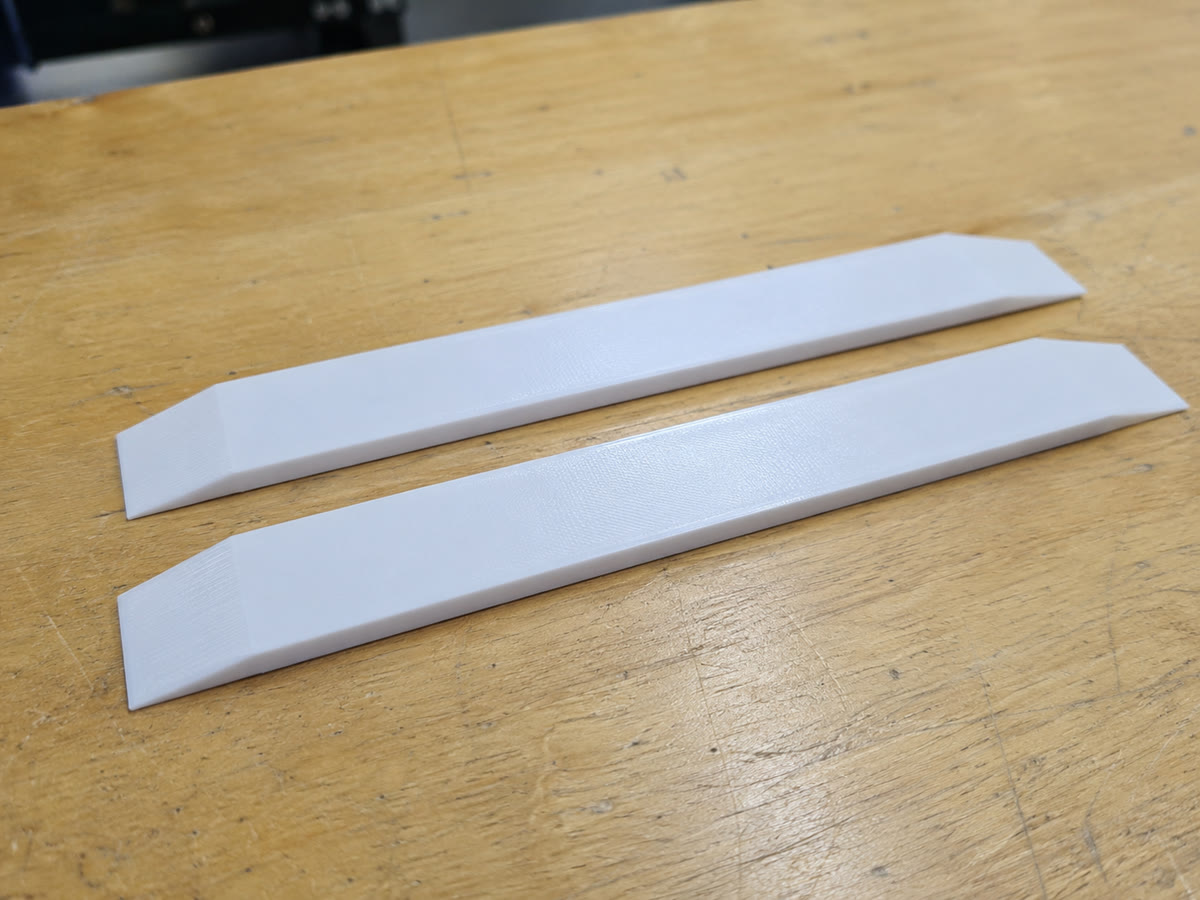
The two PETG bridges span the broken rails. Matching parts keep both sides of the drawer level.
The pieces were simple. That was the point. They didn't need to recreate the original rail. They only needed to restore the surface the wheel depended on.
Then the Wheel Broke
The bridge solved one problem and exposed the next one.
One wheel was already missing. The remaining wheel broke while I was removing it to take measurements. Suddenly I wasn't just bridging a damaged track. I needed to replace the wheel, axle, and housing, while accounting for the broken mounting points in the freezer drawer.
I photographed the surviving assembly from multiple angles with a tape measure in frame. Codex used those references to help build a new housing I could glue into place and a wheel assembly sized to run against the replacement bridge.
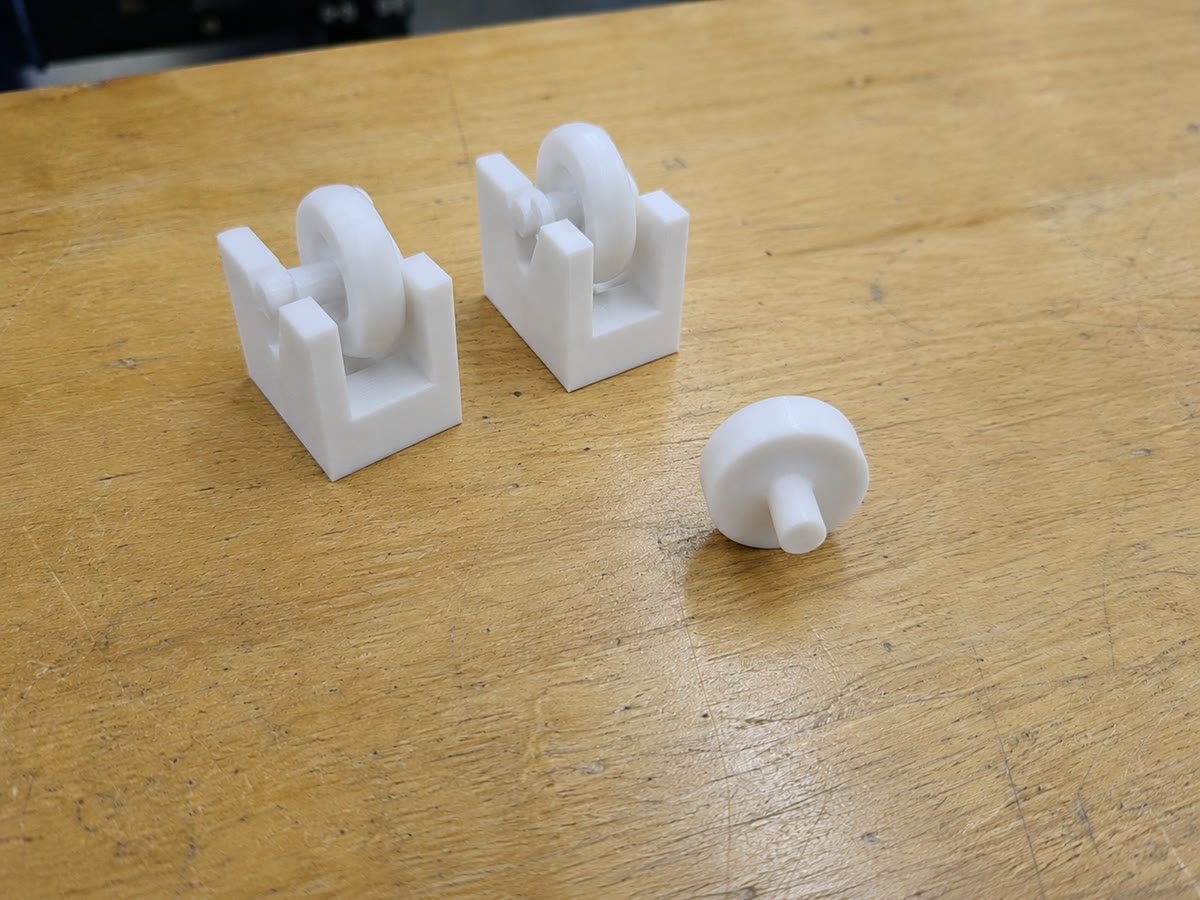
The replacement roller system: two matching housings plus an early wheel assembly used to check fit and clearance.
We printed both sides so the drawer would stay balanced. The first fit was close, but the wheel needed a little more clearance inside the housing. A few minutes with a Dremel created the extra room, and the assembly started rolling freely.
That wasn't a failure of the process. That was the process.
Photos and measurements get you close. Printed tolerances, plastic behavior, glue, wear, and the geometry of a broken appliance decide whether the part actually works. The last few percent still happen in your hands.
The completed repair works better than the original parts did before they failed.
Computer Use Changed the Workflow
Generative AI has been able to write OpenSCAD and modeling scripts for a while. Computer Use makes the workflow feel different because the agent can also work inside the same graphical software I use to prepare the print.
Codex could create and place primitives, adjust dimensions, duplicate parts, configure the plate, and help move the model toward something printable. I stayed responsible for the requirements, inspected the geometry, corrected assumptions, and tested the output against the real object.
It wasn't frictionless. Bambu Studio crashed during parts of the work. Material settings sometimes defaulted to PETG when I needed PLA. Some assemblies were hard to visualize before slicing. We had to recover, reopen files, and verify settings more than once.
The useful shift is not "AI did everything." It is that I could stay focused on the problem while the agent handled more of the mechanical interaction between the idea and the tool.
From Repair Part to Custom Product
The next experiment started with an off-the-shelf gap.
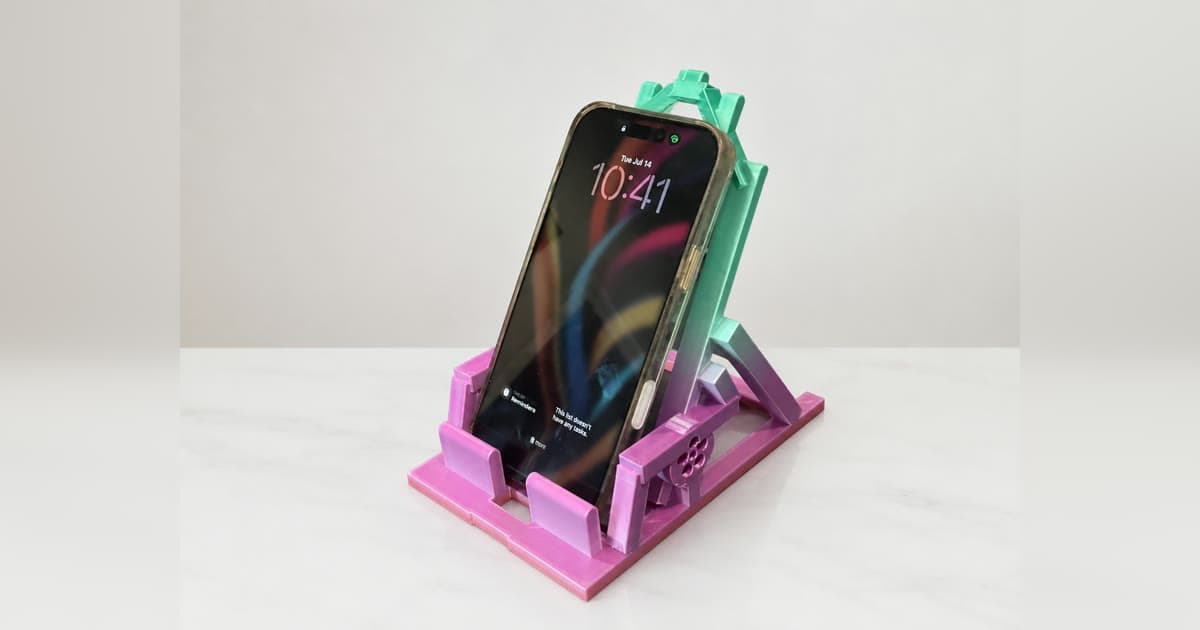
My mother-in-law uses a magnetic wallet on the back of her iPhone case. Most phone stands assume the back of the phone is flat. The wallet pushes the phone forward, changes its resting angle, and makes the front lip on many stands too shallow to hold it securely.
I wanted a stand with more clearance, but I also wanted it to feel fun. We designed it like a resort lounge chair, with an adjustable back that can accommodate thicker cases and different viewing angles. The final version was printed in PLA.
The shape is playful. The constraint is real.
That combination is what makes custom fabrication interesting. A mass-market product has to target the average phone, average case, and average use. A one-off print can be designed around one person, one accessory, and the exact way they use it.
The New Creative Loop
These projects reinforced a few practical rules:
- Measure the contact points, not just the object.
- Photograph the part from several angles with a scale in frame.
- Design clearance intentionally. A perfect digital fit can become a fused or binding print.
- Print matching parts when a repair affects alignment.
- Treat the first print as a physical prototype, not a verdict.
- Keep finishing tools nearby. A Dremel can be part of the iteration loop.
I didn't become a mechanical engineer overnight. AI didn't replace one. But the space between "I can describe the part I need" and "I can make a useful version of it" got much smaller.
That is the milestone for me. AI is no longer limited to helping me think, write, or build software. It can help turn a broken object and a rough idea into something I can hold, install, and use.
What becomes worth fixing when the cost of turning an idea into a custom part keeps falling?
Get AI strategy updates in your inbox.